
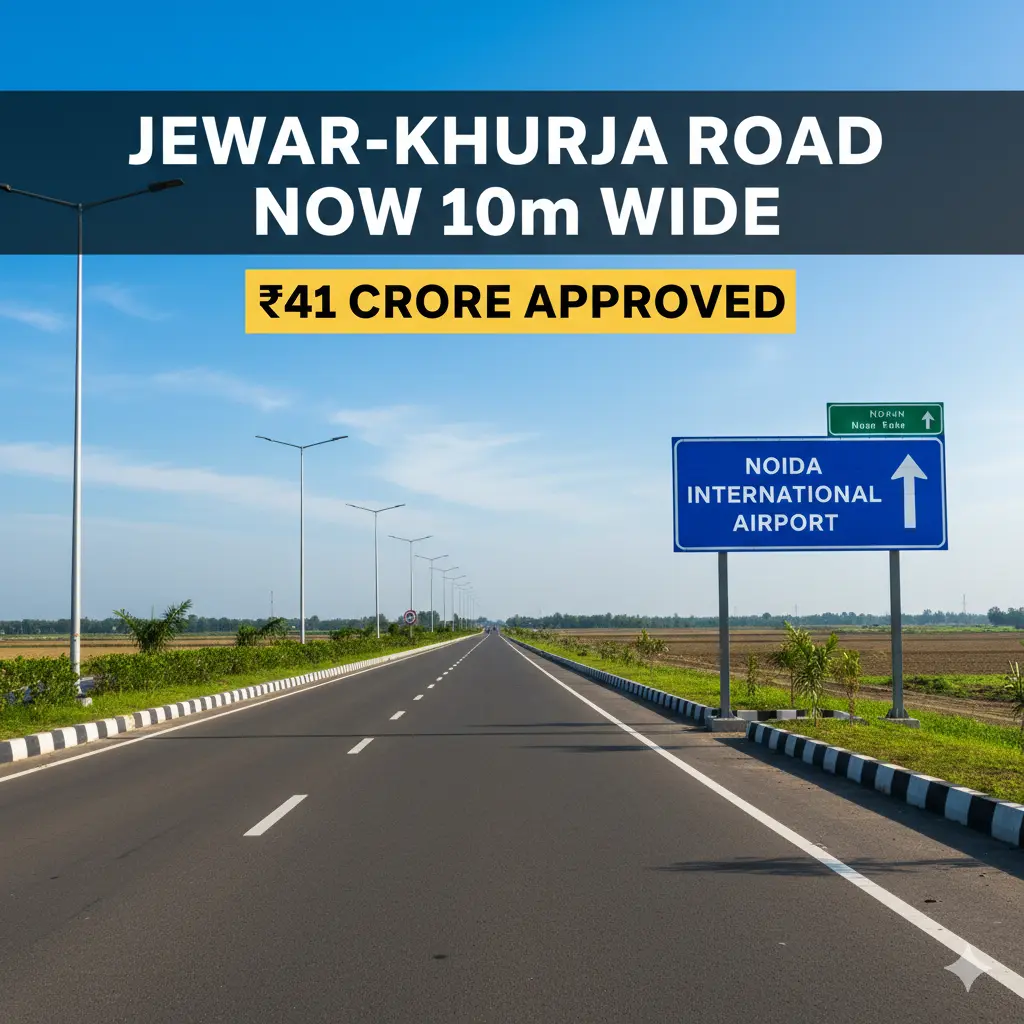
Infrastructure changes rarely happen in isolation. When roads widen, airports rise, or highways get approved, the ripple effects touch everything—from daily commutes to long-term investment strategies. The recent approval of a ₹41 crore project to expand the Jewar-Khurja Road is one such development that’s catching the attention of market watchers across Delhi NCR.
With Noida International Airport at Jewar inching closer to reality, this road widening represents more than just smoother traffic flow. It’s a signal of how the region is preparing for transformation.
What’s Actually Happening on the Ground
The Jewar-Khurja Road is being expanded from 7 meters to 10 meters—a seemingly modest increase that carries substantial practical implications. The project covers 15.433 kilometers stretching to Jahangirpur, with the Uttar Pradesh government having already released the first installment of ₹4 crore to get things moving.
This upgrade wasn’t arbitrary. Jewar MLA Dhirendra Singh initiated the proposal through the Public Works Department months ago, and Friday’s official approval marks the transition from planning to execution. The PWD will now launch the tendering process, after which actual construction begins.
For anyone tracking infrastructure developments in the region, this timeline matters. Road connectivity improvements historically precede shifts in property demand, and this project follows that familiar pattern.
Why This Particular Road Carries Weight
The existing Jewar-Bulandshahr route faces significant congestion due to ongoing airport construction activities. Heavy machinery, material transport, and construction traffic have made that corridor challenging for regular commuters. The Jewar-Khurja link offers an alternative—and once widened, it becomes a critical artery for the entire region.
After completion, travelers from several key areas will gain smoother, more direct access to the airport:
Khurja: A major industrial and commercial hub that will benefit from reduced travel time to the airport zone.
Bulandshahr: Improved connectivity for residents and businesses in this growing district.
GT Road Corridor: One of North India’s most important commercial routes, now with better linkage to the airport.
Enhanced airport accessibility doesn’t just serve travelers. It fundamentally alters the value proposition for residential developments, commercial properties, warehousing facilities, and land holdings throughout the corridor.
The Safety Factor That Often Gets Overlooked
Beyond convenience, there’s a pressing safety dimension to this upgrade. The current narrow road configuration has led to frequent accidents, particularly when smaller vehicles navigate alongside heavy trucks in inadequate space.
Widening to 10 meters addresses several hazards:
- Vehicles get proper lane discipline and maneuvering room
- Head-on collision risks decrease significantly
- Two-wheelers and passenger cars operate in safer conditions
- Emergency vehicle access improves during peak hours
Infrastructure improvements that enhance safety don’t just save lives—they build confidence. Homebuyers and businesses naturally gravitate toward areas where basic safety concerns are being systematically addressed.
Reading the Real Estate Tea Leaves
Property markets respond to connectivity. Always have, always will. The belt encompassing Jewar, Jahangirpur, and Khurja is gradually emerging as a focus area for investors who understand how infrastructure catalyzes value.
Several factors make this corridor particularly interesting:
Airport Proximity: Properties near international airports consistently command premiums due to accessibility and economic activity.
Government Commitment: A ₹41 crore budget allocation signals serious governmental intent to develop the region, not just token gestures.
Multi-Modal Connectivity: This road improvement complements the upcoming airport, existing expressways, and planned metro extensions—creating layered connectivity.
Early-Stage Opportunity: The region hasn’t yet seen the price spikes common once infrastructure is fully operational, offering a window for strategic entry.
Investors focused on fundamentals rather than speculation tend to look for exactly these conditions: government-backed infrastructure, improving connectivity, and reasonable current valuations with clear appreciation catalysts.
What Different Stakeholders Should Consider
Daily Commuters: Beyond investment implications, this upgrade directly improves quality of life. Shorter, safer commutes matter for anyone working in or around the airport zone.
Business Owners: Warehousing, logistics, hospitality, and service businesses all benefit from improved road infrastructure near a major airport.
Land Investors: Plotted developments and agricultural land conversions in this belt become more viable as connectivity improves.
Homebuyers: Residential projects gain appeal when airport access is convenient—particularly for professionals who travel frequently.
The Bigger Picture: Jewar’s Evolving Identity
This road widening doesn’t exist in a vacuum. It’s part of a broader transformation that includes:
- Noida International Airport construction advancing steadily
- Multiple expressway connections being planned or executed
- Commercial and industrial zones being designated
- Residential townships being developed by established builders
Each individual project contributes to a larger narrative: Jewar and its surroundings are transitioning from primarily agricultural land to a significant economic and residential hub.
Understanding this trajectory helps separate meaningful developments from noise. Not every infrastructure announcement deserves attention, but projects with clear timelines, allocated budgets, and strategic importance—like this road widening—merit closer examination.
Navigating the Opportunity Landscape
Government approvals and infrastructure projects create opportunities, but capturing value requires informed decision-making. A few principles apply:
Verify Official Status: Ensure projects have actual approvals and funding, not just proposals or announcements.
Assess Connectivity Comprehensively: Don’t evaluate roads in isolation—consider how they integrate with broader transportation networks.
Prioritize Legal Clarity: Infrastructure improvements don’t fix title issues or zoning violations. Always verify property documentation independently.
Think Long-Term: Infrastructure development takes time. Quick-flip strategies often underperform in emerging corridors compared to patient, strategic holding.
Seek Professional Perspective: Experienced advisors who understand both infrastructure timelines and market dynamics can help identify genuine opportunities versus overhyped projects.
Common Questions About the Jewar-Khurja Road Upgrade
How will this road widening change the area’s accessibility?
Travel times will decrease, safety will improve, and airport access will become more efficient for commuters from Khurja, Bulandshahr, and the GT Road corridor.
Should we expect property price increases after this upgrade?
Improved connectivity typically drives demand. While prices may not spike immediately, the trend historically favors appreciation in well-connected zones.
What makes the ₹41 crore approval particularly significant?
It demonstrates concrete governmental commitment to developing the airport region, moving beyond plans to actual execution.
How does this benefit people who aren’t investing in property?
Daily commuters gain safer, faster routes. Traffic flow improves. Emergency services get better access. Quality of life increases for existing residents.
Why are market professionals monitoring this development closely?
Because connectivity improvements reliably influence buyer interest, rental demand, and long-term property values.
What should someone interested in this area do next?
Research the corridor thoroughly, visit the area personally, verify infrastructure timelines, and consult with professionals who have genuine regional expertise before making any financial commitments.
Final Perspective
The ₹41 crore Jewar-Khurja road widening represents more than asphalt and construction contracts. It’s an indicator—one of many—that the region around Noida International Airport is being systematically prepared for substantial growth.
For travelers, it means easier journeys. For local residents, it means improved safety and accessibility. For investors and homebuyers, it means evaluating whether this emerging corridor aligns with their goals and timelines.
The key is approaching such developments with clear eyes: recognizing genuine progress while avoiding hype, understanding potential while remaining grounded in realistic expectations.
Infrastructure doesn’t create value on its own—it enables it. And in regions like Jewar, where multiple infrastructure pieces are coming together simultaneously, those who understand the fundamentals and act thoughtfully often find themselves well-positioned for whatever comes next.